Salesforce Implementation Corporate Carve-Out: How to Go Live in 21 Days

Salesforce Implementation Corporate Carve-Out

Carve-outs don’t fail dramatically. They fail quietly — one missed handoff at a time, one record that didn’t transfer, one commercial team that logs in on Day 1 of new ownership and finds nothing there. A Salesforce implementation corporate carve-out is one of the highest-pressure technology challenges a business can face.

For one of the world’s most recognised B2B publishers in the online gaming and gambling industry, that risk wasn’t hypothetical. The business was mid-divestment, separating from its former parent organisation as part of a wider corporate acquisition. Legal and regulatory timelines were fixed. There was no runway for a phased rollout and no tolerance for disruption. Before A5 could deliver a clean go-live, we had to solve a complex infrastructure problem at pace.

THE CHALLENGE : When a Market Leader's Revenue Engine Is Running on Spreadsheets

Speed defines carve-outs. But this client was blocked. Infrastructure owned it.

The client’s entire commercial operation ran on a Salesforce instance owned by its former parent organisation. That environment would cease to be accessible after transition day. The business needed its own clean, independent CRM — built from scratch, populated with almost 500,000 of its own records, and configured to reflect how its commercial team actually sells.

The separation was business-critical for four interconnected reasons:

Acquisition support: The carve-out had to complete cleanly to support the wider acquisition of the former group entity.

Regulatory compliance: Legal and regulatory requirements tied to the transaction had fixed deadlines that could not slip.

Business continuity: The client’s commercial teams needed uninterrupted access to pipeline, contacts, and opportunities throughout the transition.

Day 1 readiness: The new organisation had to be fully operational from the moment ownership transferred — not days or weeks later.

A5 was brought in to design, build, migrate, and deploy that environment in just three weeks. Here is exactly how we delivered a Salesforce implementation corporate carve-out programme — on time, without disruption, and built to last.
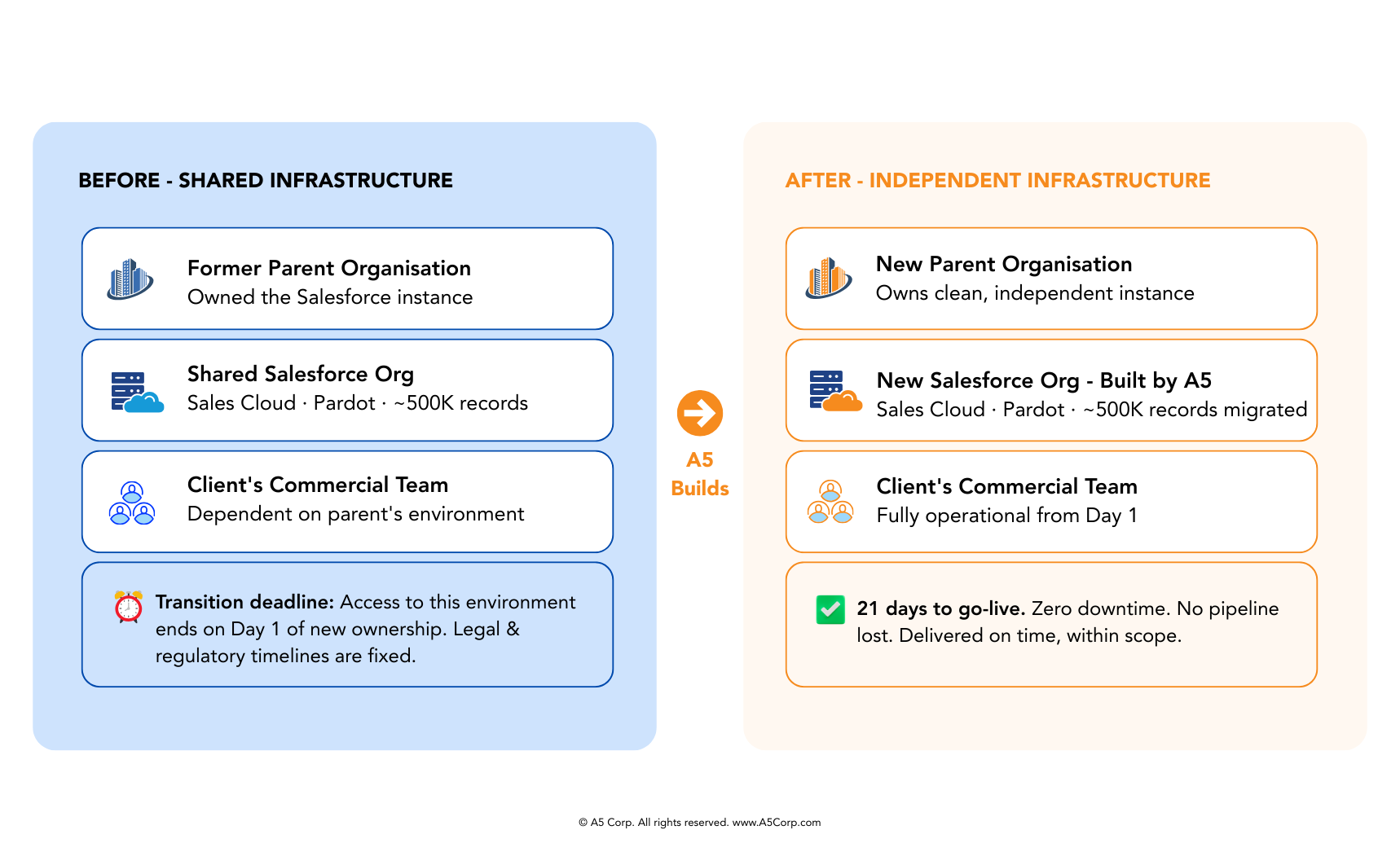
Before & After the Carve-Out

The Objective: Scope Discipline as the Only Path to Day 1

When a deadline is fixed by legal and regulatory timelines, there is no room for ambition to outrun reality. The temptation in a project like this is to fix everything at once. That temptation had to be resisted.

The brief A5 received was deliberately constrained. A purposeful, light-touch implementation — not an overengineered transformation. The mandate: get the client operational on Day 1 and build a foundation solid enough to grow on. That made scope discipline the most important decision on the project.

Four priorities were non-negotiable from the start:

  • Standard objects only: Leverage standard Salesforce objects wherever possible — no unnecessary customisation consuming time the project didn’t have.
  • Clean migration: Extract and migrate client-specific data from the legacy instance accurately and completely.
  • No data cleansing: Avoid cleansing work that would expand scope and blow the timeline without adding Day 1 value.
  • Scalable foundation: Establish a robust architecture the new organisation could build on with confidence for years to come.

Beyond infrastructure, the new system had to reflect how the client actually sells — supporting Leads, Accounts, Contacts, Opportunities, Campaigns, Products, Assets, Licences, and Revenue Schedules, with product scheduling functionality replacing legacy custom objects and opportunity management restructured for multi-product, multi-line item selling.

The Solution: A Unified Salesforce Revenue Engine — Built for Speed

A5 accepted the challenge. We didn’t just migrate the data — we delivered a business continuity programme, not a software deployment. A Salesforce implementation corporate carve-out demands more than technical configuration. It requires solving the human, process, and architectural problems that make technology either succeed or fail. That’s what a CRM implementation partner is actually for.

The Salesforce Org Migration: No Inherited Debt

A5 managed the Salesforce org migration from the legacy instance into a clean, independently provisioned environment — with no inherited configuration debt and no data the client didn’t own. We streamlined legacy configuration, replaced years of accumulated custom workarounds with purposeful out-of-the-box Salesforce features, and established the right access controls, security model, and governance structure from the ground up. The constraint of the timeline became an opportunity to build it better.

Sales Cloud & Account Engagement: Built for How the Client Actually Sells

Generic CRM configurations fail because they are built for hypothetical sales processes, not the one your team actually uses. When a system doesn’t reflect reality, reps work around it — and the moment that happens, data quality and adoption collapse. A5 configured Sales Cloud (Agentforce Sales) and Pardot (Agentforce B2B Automation) to match the client’s commercial model precisely:

  • Revenue schedules: Aligned to advertising and reporting products.
  • Multi-product opportunities: Restructured from single to multi-line item selling model.
  • Campaign alignment: Sales and marketing processes connected end-to-end.
  • Licence object: New custom object to store subscription details accurately.
  • Pipeline management: Standardised yet flexible — leadership visibility without restricting how reps work.

The Salesforce Data Migration: Almost 500,000 Records in Under 3 Weeks

We utilised Talend to execute the Salesforce data migration — extracting client-specific data from the legacy Salesforce Sales Cloud instance and migrating Accounts, Contacts, Leads, Opportunities, and Products into the new environment. A5 transformed the data to fit the standard Salesforce model, enhancing long-term scalability without unnecessary complexity. Every record the commercial team needed on transition day was in the new system, verified and ready.

DevOps & Governance: Built for What Comes Next

A5 implemented a DevOps process for ongoing change management and controlled releases. The underlying data architecture, process design, security model, and governance structure were all built for long-term scale — not just immediate operational readiness.
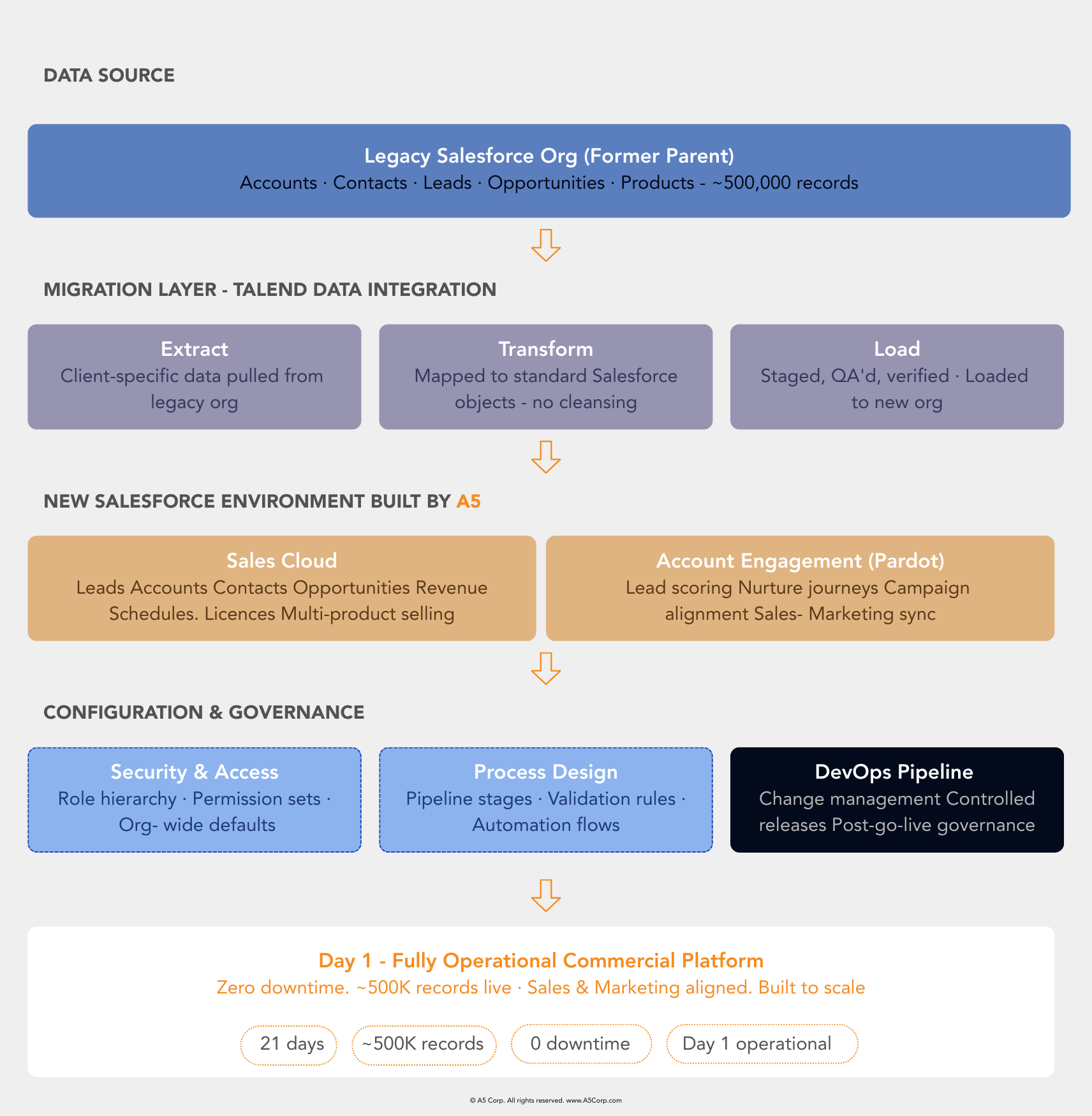
Full Salesforce Architecture

Why It Worked: Process First. Scope Discipline Second. Technology Third.

Why did this succeed? Because we treated the Salesforce implementation corporate carve-out as a strategic operation, not a technical ticket.This is how you deliver a clean, production-ready system in 21 days — not by moving faster, but by eliminating the rework cycles that slow most projects down.

Migration and Build Ran in Parallel

The Talend data migration workstream ran in parallel with platform configuration from week one. This was a deliberate architectural choice that kept the project on track without compromising what was delivered.
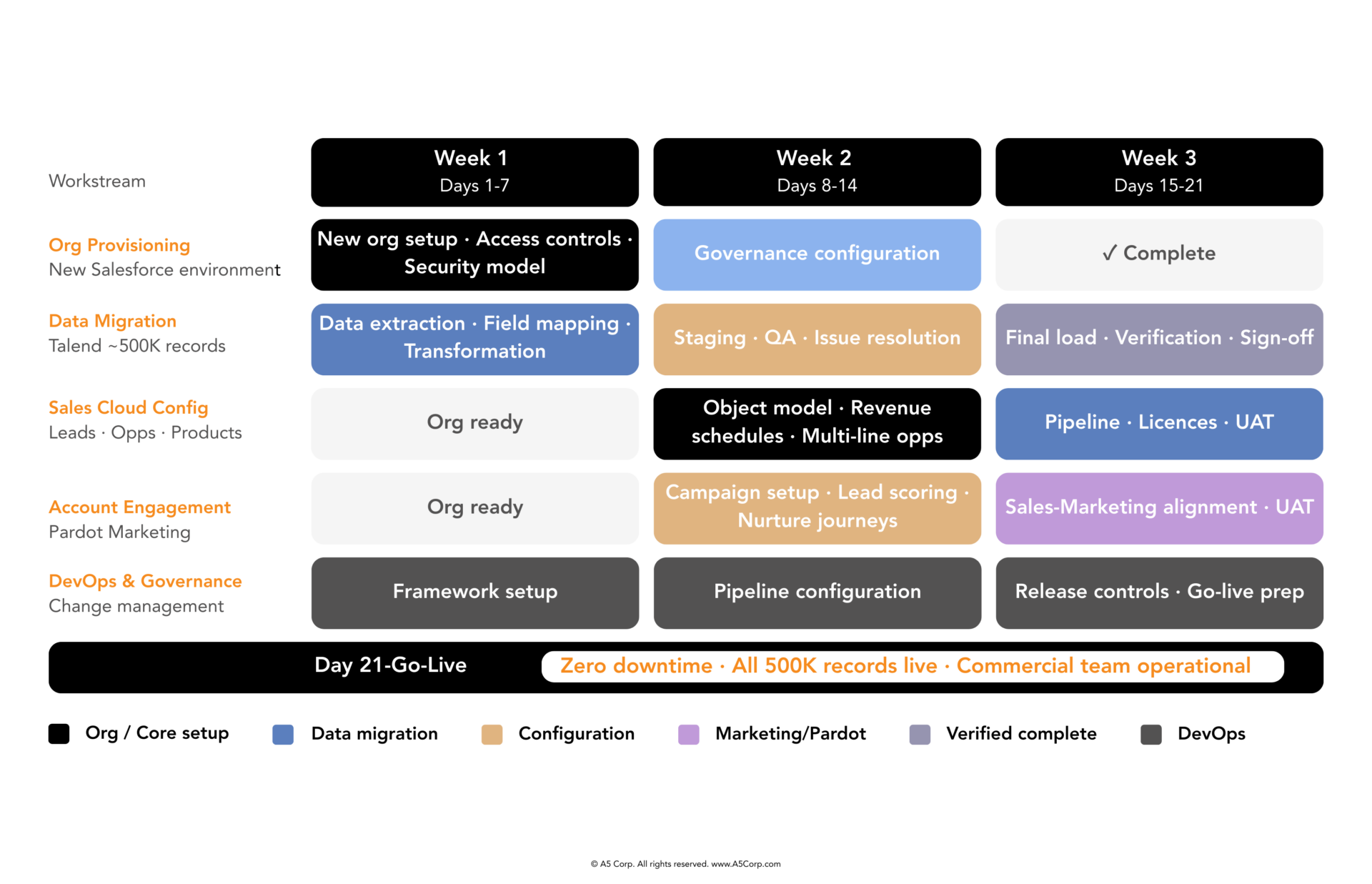
Parallel Workstreams

“The organisations that succeed with Salesforce sales and marketing alignment are the ones that design the process first and let the technology follow. Pardot and Sales Cloud are powerful— but they amplify whatever process you feed them. If you skip the alignment work upfront, you will automate the same dysfunction you already had. Just faster.”

Senior Salesforce Revenue Architect, A5

The Impact: Day 1 Operational Readiness — Delivered

The results were unambiguous. On Day 1 of the new organisation, the client’s commercial team logged into their new Salesforce environment and worked without interruption, without productivity loss, and without a single piece of pipeline falling through the transition.

  • Live in 21 days: Fully operational Salesforce Sales Cloud within three weeks of the project request.
  • 500,000 records migrated: Accurately and without data loss — the team picked up exactly where they left off.
  • Zero disruption: No downtime, no productivity loss, no pipeline dropped during the transition.
  • Day 1 operational: Commercial team live and working in the new system from the moment ownership transferred.
  • Compliance met: Regulatory and legal requirements fully supported throughout.
  • Built to scale: Strong architectural foundation for long-term growth under new ownership.

Corporate carve-outs don’t have to be as painful as they look from the outside. With the right expertise, architectural discipline, and a partner who has operated under this kind of pressure before, Day 1 readiness is achievable — however tight the window.

Frequently Asked Questions on Salesforce Carve-Out Implementations

How long does it take to implement Salesforce during a corporate carve-out?

With disciplined scope management and a dedicated implementation partner, a light-touch Salesforce Sales Cloud environment can be live in as little as 21 days. This requires provisioning new orgs, configuring the platform to match existing sales processes, and running data migration in parallel with the build — not sequentially. The critical constraint is not technical speed but scope discipline: limiting customisation to what is strictly necessary and avoiding extensive data cleansing work that expands timelines without adding Day 1 value.

Can you migrate hundreds of thousands of CRM records in under three weeks?

Yes — with the right tooling and architectural decisions. Using Talend for extraction and transformation, A5 migrated almost 500,000 business records from a legacy Salesforce instance into a brand-new environment in under three weeks. The critical decision was to transform data to fit standard Salesforce objects rather than performing extensive cleansing, which protected the timeline without compromising data integrity or continuity.

What are the Salesforce migration risks in a carve-out?

The biggest Salesforce migration risk in a carve-out is scope creep. Well-intentioned decisions — like pursuing full data cleansing or building custom objects — can derail a go-live deadline. A5’s approach prioritises what is required for Day 1 operational readiness and defers everything else to a governed post-go-live roadmap.

What Salesforce products are needed for a carve-out CRM implementation?

A typical Salesforce implementation corporate carve-out uses Salesforce Sales Cloud (Agentforce Sales) and Marketing Cloud Account Engagement/(Pardot (Agentforce B2B Marketing Automation), alongside Talend for data migration and a DevOps framework for post-go-live change management.

How do you ensure a Salesforce implementation supports both Sales and Marketing from Day 1?

Alignment between Sales and Marketing in Salesforce is a process and governance decision, not a technical one. A CRM implementation partner configures campaign structures, lead management workflows, and shared pipeline visibility that connect Sales Cloud and Account Engagement into a single commercial model — configured to reflect how both teams actually operate, so adoption is immediate rather than requiring behaviour change under pressure.

Ready to move off a legacy CRM under carve-out pressure?

 — your Salesforce Revenue Transformation partner — for a no-obligation assessment.
Get the latest articles right in your inbox

Explore our posts

Agentforce Accelerated pop up

Agentforce Accelerated.

Introducing AgentIQ — our new proprietary IP is now LIVE on the Salesforce AppExchange/ AgentExchange.

Don’t build your AI agents from scratch. Deploy pre-built, zero-configuration agents compatible with both Agentforce Sales (Sales Cloud) and Agentforce Service (Service Cloud) immediately.

Sales: Automate Account Summaries & Quote Creation.

Service: Resolve cases & search knowledge in minutes.

Risk-Free: Freemium model available.

Satch Patel, Executive Vice President, MD, UK & EMEA

Satch brings 25+yrs of enterprise global solution experience having contributed to the growth of some of the worlds largest marquee software and hardware giants in the industry from Oracle Corporation, Sun Microsystems, Cisco/EMC, to Apttus & Salesforce.
 
Satch has helped many blue chip organisations realise their vision to modernize their systems from the front office to back office revenue operations to meet the demands of today’s radically transforming and digitally-driven business models, having worked with the likes of Linklaters, CliffordChance, Barclays, RELX Group, Microfocus, Novartis, Siemens, PayPal, Vista Equity Group Companies, London Stock Exchange, TPICAP and Princes Trust.
 
With his leadership approach, experience and passion for helping companies drive transformative change, Satch has a deep expertise in many industries, technologies and best practices across the lead to revenue lifecycle and how driving such digital transformation(s) can improve business growth and increase operational efficiencies  as well as preparing businesses for M&A activities.

Brion Schweers, Board Observer

Brion Schweers brings over 30 years of experience in the “Product-to-Cash” ecosystem. He previously served as the Senior Vice President of Product Management at Salesforce, where he managed the Revenue Cloud Solution Excellence team and helped enterprises globally transform their revenue models.
Prior to his tenure at Salesforce, Brion was the VP & GM of CPQ at Apttus and served as VP of Sales & Success at A5 Consulting. A passionate advocate for veterans, Brion is an Executive Sponsor of Vetforce and actively mentors veterans through the Salesforce Military program, providing personalized career advice to the next generation of leaders.

Joseph Truhe, Board Member

Joseph Truhe has over 20 years of investing experience. Prior to joining Jefferson Capital in 2013 Joseph was a Portfolio Manager with Whitney Bank in New Orleans, Louisiana, where he oversaw the company’s Trust accounts and served as the Energy sector analyst for the Hancock Horizon Funds. Prior to Whitney, Joseph worked as an analyst and member of the investment committee at HFR Asset Management, a multi-billion dollar hedge fund platform in Chicago, Illinois. There, Joseph reviewed and maintained investment discretion over the firm’s Event Driven and Asia-focused hedge fund allocations. He was also responsible for the expansion of the firm’s Asia-focused fund offerings.  Joseph holds a BA in Economics from Yale University.

Steve Swartzman, Board Member

Steve Swartzman is a Principal and co-founder of CPC. Previously, as a co-founder of C3 Capital, he helped originate and manage over 35 investments, including national brands such as American Apparel, Traeger Grills, and Grunt Style. Steve’s chief focus remains consumer brands and e-commerce enablement businesses, and he currently serves on the boards of Grunt Style, Accel Clinical Research, Spoke Custom Products, Warne Scope Mounts, and New World Natural Brands.

Prior to C3, Steve structured and managed subordinated debt investments at KC Venture Group, and he spent 7 years as a Vice President with Citibank in New York, managing client relationships for emerging markets clients and structuring over $1 billion in complex trade financings. He is a past President of the Midwest chapter of the Small Business Investment Alliance, and he serves on the board of the International Center for Music at Park University in Kansas City.

Steve received a MBA from Columbia Business School and an AB in History and Literature from Harvard College.

He resides in Kansas City, where he was raised, with his wife Evelina and two sons, Harrison and Zandy. When he’s not working, his favorite activities are fishing, golfing, and eating.

Charles Scripps, Board Member

Chad has over ten years of experience investing in dynamic, growing businesses in diverse industries and geographies. His private equity experience includes HIG Capital, which has over $12B in capital under management, and AEA Investors, which manages over $3B of invested and committed capital. While at HIG and AEA, Chad led diligence, structuring, and financial analysis of potential and existing investments, and completed transactions in the industrial products and consumer services industries. Chad also has experience investing in the public equity markets, most notably as a Managing Director at Fox Point Capital, a $1B fund seeded by Julian Robertson of Tiger Management. He invested across a number of industries, including industrials, financials, technology, and consumer products, and led Fox Point’s international research. Prior to focusing his career on investing, Chad was a management consultant at McKinsey and Company, solving strategic problems for the world’s leading companies. Chad earned an MBA with Honors in Finance from the Wharton School at the University of Pennsylvania and a BS with Distinction in Chemical Engineering from the University of Wisconsin-Madison.

Lester F. Alexander II, Board Member

Les Alexander is a partner with Jefferson Capital Partners where he provides mezzanine and equity capital for growth and buyout transactions. Mr. Alexander is a member of the firm’s investment committee and serves on the board of directors of several portfolio companies where he is actively involved in strategic planning and corporate governance. Prior to joining Jefferson Capital, he worked at Advantage Capital Partners where he completed several portfolio company investments and served on the investment committee. Before becoming a private equity investor, Mr. Alexander served as president of Ferrara Fire Apparatus, Inc., a leading fire truck and emergency vehicle manufacturer. At Ferrara, he was responsible for managing a workforce of 450 employees producing over 300 vehicles annually for its domestic and international customers. As an investment banker for 15 years with such firms as Howard Weil, Southcoast Capital, and J.C. Bradford & Co., Mr. Alexander completed over 50 public offerings of debt and equity securities, private placements, and merger and acquisition transactions totaling more than $7 billion for public and private companies in a variety of industries. Mr. Alexander is an adjunct professor at Tulane University and Loyola University where he teaches graduate and undergraduate classes in investment banking, private equity & venture capital, advanced financial management, investments, and entrepreneurship. He is also the board president for Benjamin Franklin High School, a public charter school in New Orleans. Mr. Alexander is the former Chairman Finance of the Association for Corporate Growth (ACG) and served on the global Board of Directors. He is a founder of the Louisiana chapter of ACG and was a recipient of the ACG global Meritorious Service Award and the Louisiana chapter’s Outstanding Service Award. Mr. Alexander received his bachelor of science in Commerce from the University of Virginia in 1989 and his MBA from the University of North Carolina in 1993.

Patrick F. Healy, Board Member

Based in Kansas City, Mr. Healy is a co-founder of C3 Capital. He has been an active private equity investor since 1985 and was a co-founder of C3 Holdings in 1994. Prior to this time, he sponsored and structured equity investments in real estate. He gained extensive workout and restructuring experience as chair of the creditor’s committee of a $1 billion bankruptcy and from being called upon to rescue a publicly-traded company from a major fraud. Mr. Healy was a senior tax partner at Mayer Hoffman McCann, a regional CPA firm, for eleven years. He received a Bachelor of Science in Accounting from the University of Kansas.

Chris Waters, VP of Strategic Sales

As Vice President of Strategic Sales, Chris guides and influences all strategic sales activities at A5 , starting in presales activities, successful sales methodology, sales process, and continued revenue generation and expansion opportunities. Furthermore, he will provide oversight in strategic sales function for the company and develop strategic sales plans that will promote growth in sales and customer satisfaction. Chris has proven his commitment to sales leadership and organizational success through field leadership as National Sales Manager at Deluxe Corporation, Field Sales Manager within the Social / Analytics Cloud at Oracle, US Regional Manager for CPQ Major Accounts at Oracle and now as Vice President on Sr. Leadership Team at A5.

Keith Fox, GM Salesforce Canada

Keith Fox is a software and consulting veteran for the past 34 years. Keith started his career at EDS which was followed by 4-year stint offshore in Bermuda. Keith then returned to Canada where he held a number of progressive sales and technical positions with software companies such as Sybase, BEA, and Oracle. After his stint with Oracle, Keith founded Cloudware Connections, a premier Salesforce consulting partner. 11 years down the line, Cloudware was acquired by A5, and Keith joined as GM for Canada.

Tarun Sharma, Vice President Delivery

Tarun Sharma is Vice President Delivery at A5 and is responsible for customer success, project operations, recruitment, resource utilization, and sales operations functions for Oracle practice. As a business and technology leader Tarun helps businesses develop solution strategies to streamline the sales process and improve customer relations to drive revenues, profits, and build brand loyalty. Tarun has led customers through digital transformation journeys. He has commanded strategic and tactical initiatives to shorten sales cycles, increase deal values and productivity, improve brand awareness and help organizations become easier to do business with. He has helped customers modernize their sales enablement tools and present a single source of information to support an omni-channel sales approach. This includes global roll-out for multiple business units included multi-currency and multi-language. Tarun graduated from Texas A&M University with a Master’s degree in Industrial Engineering.

Adam Rosenfield, VP of Salesforce Practice

As Vice President of A5’s consulting practice – Adam is responsible for both strategic alliances with partners and expanded sales growth through the entire portfolio of A5 services. With over 20 years of Sr. level management consulting expertise – Adam has worn multiple hats in his career including practice development, sales, and client advisory. He has sold & delivered countless enterprise transformational initiatives creating a measurable competitive advantage for his customers. In addition to various technical software certifications, Adam holds an undergraduate and master’s degree in Accounting & Information Technology from the University of Texas at Austin and resides in El Paso Texas with his wife and 3 children.

PJ Alfrejd, CFO

As the CFO, PJ is responsible for all things financial at A5. With over 20 years of experience in financial leadership positions, PJ has worn all the hats required of a growing tech business. His extensive knowledge of the consulting industry, experience with M&A, and strength in operational finance is another catalyst to take A5 to the next level in its growth trajectory. PJ is a CPA with a BS in Accounting from the University of Illinois, Urbana-Champaign, and has held various finance leadership positions at Exodus/Savvis (acquired by Centurylink), Neohapsis (acquired by Cisco), and mFoundry (acquired by FIS).

Vinay Kruttiventi, President & CEO / Chairman of the Board

As the CEO of A5, Vinay plays an active role in all aspects of day-to-day business operations. He is also actively involved in establishing a strategy and vision for the company. As a true customer advocate with Salesforce and Oracle product development, Vinay is actively engaged in various industry user/special interest groups. Since founding the company in 2004, Vinay has grown the business into a leading Salesforce, and Oracle partner focused on multi-cloud transformations.

Vinay has successfully implemented and architected CPQ solutions and multi-cloud complex transformation projects for various Fortune 500 companies since 1996. He has a strong authority over industry, process, and technology in Configure-Price-Quote and ERP applications. Vinay graduated from Osmania University with a Bachelor of Engineering degree and JNTU (Jawaharlal Nehru Technical University) with a Master in Technology degree.