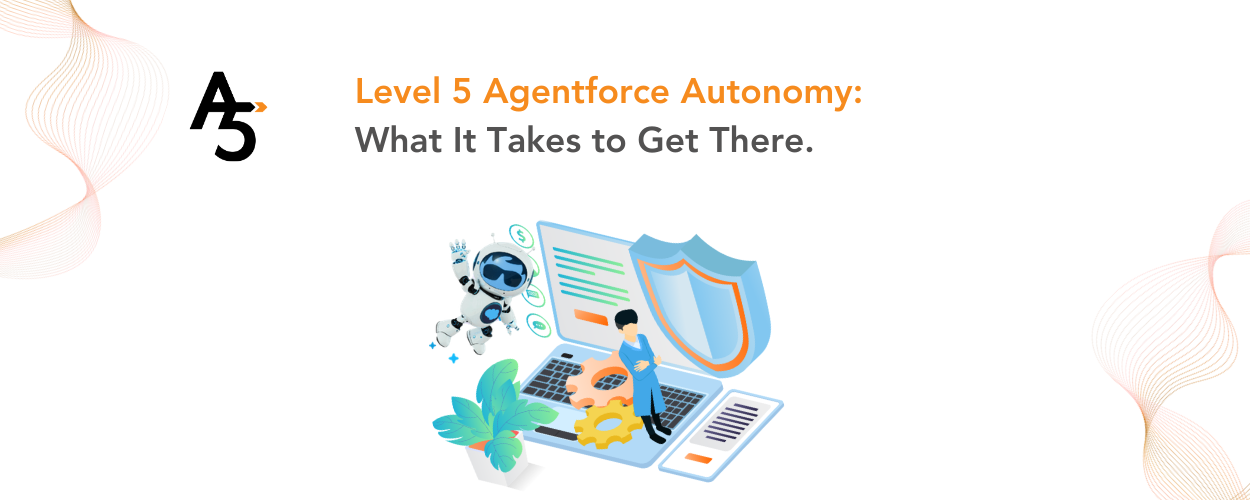
Agentforce autonomous deployment at Level 5 — where agents own entire business workflows without human intervention — is the most discussed and least delivered outcome in enterprise Salesforce AI today. According to Salesforce’s 2025 Connectivity Benchmark Report, 93% of IT leaders plan to deploy autonomous agents within two years, and nearly half already have. Yet Salesforce’s own Agentic Enterprise Index reveals the defining paradox: agent creation surged 119% in the first half of 2025, while human escalations simultaneously rose from 22% to 32%. Deployment is accelerating. Autonomy is not. And almost all stalled deployments share one structural gap: they are solving for a single function, when the real competitive advantage lives across all of them.
There is a moment every enterprise AI leader recognises. The pilot worked. The stakeholders are aligned. The agents are live. And then, six months later, the same humans are still approving the same decisions. Escalation queues are unchanged. The ROI case is harder to defend than the deck promised. The agents are useful. They are not autonomous. This is not a Salesforce problem. It is a maturity problem with a precise name: the deployment is stalled at Level 3. Level 3 agents execute tasks within a single function. Level 5 Autonomous Digital Workers own outcomes across functions — end to end, without handoffs, without escalation queues, without a human in the operational loop. The architecture required to get from one to the other is not an upgrade. It is a rebuild.
Our name is not a coincidence. A5 stands for Level 5 Autonomous AI — the highest level of agentic capability, where agents own entire enterprise outcomes without human intervention. The 5As — Audit, Align, Advise, Attain, Assist — are our proven framework for getting there, refined across twenty years of enterprise Salesforce transformation. AgentIQ is what makes it achievable in six weeks. This is that framework, applied across all five enterprise functions.
The question in 2026 is not whether to deploy Agentforce. It is whether your deployment reaches the level where agents own outcomes — not just actions — across every function that drives your business.
Key Takeaways For CIOs, RevOps Leaders, And Salesforce Architects
✓ 93% of IT leaders plan to deploy autonomous agents. Yet as deployments surged 119% in 2025, human escalations rose in parallel — deployment and autonomy are not the same thing (Salesforce Connectivity Benchmark / Agentic Enterprise Index, 2025).
✓ Level 5 autonomy is not function-specific. The highest ROI comes from agents that cross departmental boundaries.
✓ A5 is the brand and the standard: Level 5 Autonomous AI, delivered through the proven 5As — Audit, Align, Advise, Attain, Assist.
✓ Six AgentIQ modules: SalesIQ, RevOpsIQ, OrderIQ, AssistIQ, EngageIQ, and BookIQ — all Salesforce-native, zero-configuration, available on AppExchange.
✓ Pilot to production in 6 weeks vs 75.5 months for custom agentic builds (Valoir, 2025). $100M+ in verified Salesforce customer cost savings. 34% productivity increase.
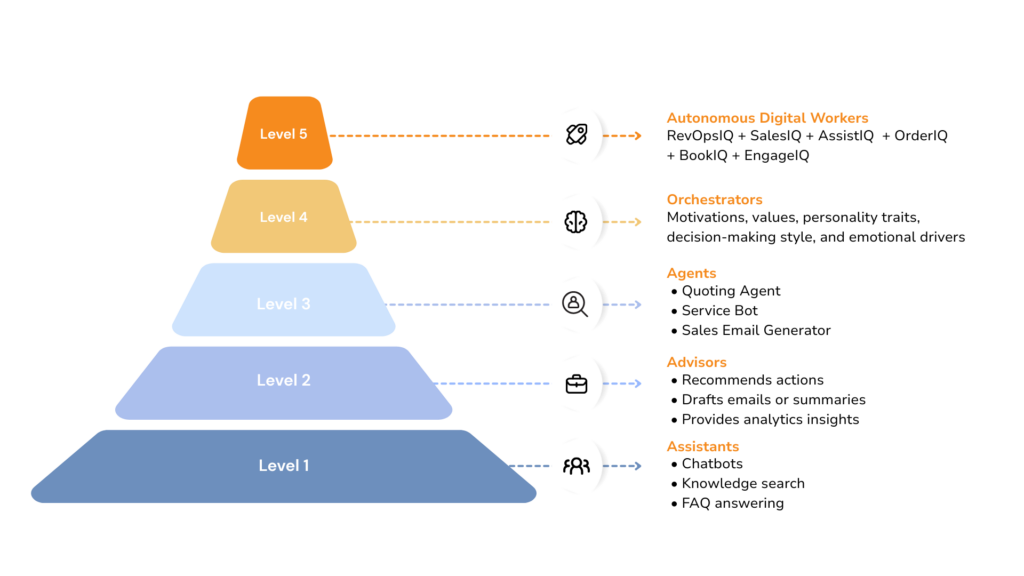
The Five Levels of Agentforce Maturity — And Where Enterprise Deployments Actually Land
Enterprise AI maturity builds in stages. Each stage requires a different architecture. The mistake most organisations make is assuming that a live Agentforce deployment means they have arrived at autonomy. In practice, the vast majority of deployments land at Level 3 — functional, demonstrable, and fundamentally limited in commercial impact.
The distinction that matters for every CIO, RevOps leader, and Salesforce architect in 2026 is not between Level 1 and Level 3. It is between Level 3 and Level 5 — and the architectural decisions that determine which side of that line your deployment lands on.
| Level | Capability | What It Means in Practice | Where A5 + AgentIQ Intervenes |
|---|---|---|---|
| Level 1 - Assistants | Responds to prompts | Chatbots, copilots. Reactive. Useful for simple queries. | Foundation only. Entry point, not a business outcome. |
| Level 2 - Advisor | Recommends actions | AI that analyses, drafts, and surfaces insights on request. | Most orgs start here. Productivity gain without autonomy. |
| Level 3 - Agents | Executes defined tasks | Bots that act across one function — but escalate when complexity or data gaps appear. | The most common stall point. Salesforce's Agentic Enterprise Index shows human escalations rising even as deployments grow — a sign that most agents stop here. |
| Level 4 - Orchestrators | Manages multi-step workflows | Agents that coordinate across systems and self-correct mid-task. | AgentIQ hybrid engine + Zero-Copy Data Cloud enables this. |
| Level 5 - Autonomous Digital Workers | Owns outcomes end to end | Executes entire business workflows across departments. No human in the operational loop. | The A5 destination. AgentIQ delivers it in ≈6 weeks. |
The three architectural gaps that separate Level 3 from Level 5 are consistent across every enterprise we have audited: fragmented data that prevents cross-functional decision-making, natural language execution that cannot be trusted at financial-grade accuracy, and human handoff loops that are not safety mechanisms — they are incomplete architecture dressed up as governance.
Level 3 agents take actions within a function. Level 5 Autonomous Digital Workers own outcomes across functions. No amount of prompt engineering closes that gap. Only architecture does.
Why Single-Function Thinking Is Capping Your Agentforce ROI
Most Agentforce deployments are scoped by department. Service gets a bot. Sales gets a copilot. Revenue Operations gets a quoting agent. Each one solves a real problem. None of them reaches Level 5 — because Level 5 outcomes live at the intersection of functions, not inside them.
A renewal is not a Sales event. It is a Service history, a billing status, a margin calculation, and a relationship signal arriving simultaneously. A scheduling failure is not a booking problem. It is a customer satisfaction risk, a revenue forecast impact, and a service delivery gap all at once. An employee’s unanswered onboarding question is not an HR overhead. It is a knowledge transfer gap, a project continuity risk, and a customer relationship vulnerability.
The organisations that reach Level 5 are the ones that stop scoping agents by department and start architecting agents around outcomes. A5 is the methodology that makes that transition possible. AgentIQ is what makes it fast.
Agentforce Autonomous Deployment Across Five Enterprise Functions
Here is what Level 5 looks like in practice — delivered through six AgentIQ modules, each purpose-built for a specific enterprise pain point, all Salesforce-native and available on the AppExchange with a freemium option to test before you scale.
Revenue & Quote-to-Cash — RevOpsIQ
The Level 3 stall: A Level 3 quoting agent drafts a renewal and stops. The margin check, the quote adjustment, the Revenue Cloud update, and the P&L reconciliation all route to humans. Every touchpoint is a delay and a cost.
AgentIQ at Level 5: RevOpsIQ is A5’s autonomous Revenue Operations agent for Salesforce Revenue Cloud and Slack. It unifies data from Sales (now known as Agentforce Sales), Service now known as Agentforce Service), and Revenue Cloud (now known as Agentforce Revenue Management) clouds directly into Slack channels, delivering real-time deal summaries, approval nudges, and next-best-action recommendations. When a renewal stalls, RevOpsIQ calculates the quote adjustment against pre-set margin guardrails and executes the renewal autonomously — closing the full Campaign-to-Cash loop without human handoffs. Quote-to-cash approval cycles accelerate by up to 30%.
Result: Full Q2C execution without swivel-chair processes. Renewals actioned autonomously. P&L updated in real time. Quote discount >15% triggers automatic Finance notification with margin analysis. Opportunity stalled at Legal >7 days triggers auto-escalation with contract summary.
Service & Support Deflection — AssistIQ + OrderIQ
The Level 3 stall: A Level 3 service agent answers FAQs from a static script and creates cases for everything else. WISMO (‘Where Is My Order?’) calls pile up. Agents spend time on queries that should never reach them. First-contact resolution remains stubbornly low.
AgentIQ at Level 5: AssistIQ is A5’s intelligent self-service agent for Salesforce Service Cloud (now known as Agentforce Service) and Slack. It instantly searches Salesforce Knowledge, PDFs, and documentation to answer repetitive FAQs without human involvement — and smartly escalates complex issues to live agents when needed. OrderIQ works alongside it: autonomously retrieving order status and updating cases without human intervention, reducing WISMO calls by up to 40%. Together they form a two-layer deflection architecture: AssistIQ handles knowledge, OrderIQ handles order fulfilment queries.
Result: Up to 40% reduction in WISMO calls (OrderIQ). Significant deflection of low-complexity cases (AssistIQ). Service agents freed to handle the cases that genuinely require human judgment. CSAT drop >10% post-case triggers automatic service recovery workflow.
Service & Support Deflection — AssistIQ + OrderIQ
The Level 3 stall: Sales reps spend 60% of their time on admin: drafting emails, summarising opportunities, updating forecasts, chasing approvals. Every hour spent on administration is an hour not spent in front of a customer.
AgentIQ at Level 5: SalesIQ is A5’s generative AI assistant for Salesforce Sales Cloud. It uses Einstein GPT to draft personalised emails, summarise opportunities, and surface next-best-action recommendations autonomously. Pipeline health is monitored across the full Sales Cloud data model and Data Cloud behavioural signals simultaneously — prioritising opportunities by margin, not volume, and routing churn-risk accounts to the right Success Manager before the customer signals intent to leave. Churn risk >30% triggers automatic scheduling without rep involvement.
Result: Sales rep productivity increases as agents handle email drafting, opportunity summaries, and forecast hygiene autonomously. Reps focus exclusively on conversations that require human judgment: complex negotiation, relationship recovery, and strategic accounts.
Customer Experience & Scheduling — BookIQ
The Level 3 stall: Appointment scheduling is deceptively expensive. Calendars are managed manually, conflicts require human coordination, no-shows go unaddressed, and customers waiting for a callback or a field visit have no self-service option. The administrative burden falls on staff who should be focused on delivering the service, not booking it.
AgentIQ at Level 5: BookIQ is A5’s automated scheduling agent for Salesforce Scheduler. It manages calendar availability and books appointments directly via chat or web — without human coordination at any step. Customers self-schedule, reschedule, or cancel through a conversational interface. BookIQ handles conflict resolution, sends confirmations, and triggers pre-appointment workflows automatically. For field service operations, it integrates with Salesforce Field Service to give technicians mobile-first, zero-touch access to scheduling data directly from Slack.
Result: Scheduling conflicts eliminated. No-show rates reduced through automated confirmation and reminder sequences. Customer self-service extended across the full appointment lifecycle. Field technicians receive job assignments and updates without dispatcher intervention.
Internal Knowledge & Employee Onboarding — EngageIQ
The Level 3 stall: New hires ask the same questions. Senior employees answer them. Internal support tickets pile up around HR policies, sales plays, IT processes, and system access. Knowledge exists inside the organisation but is not accessible in the moment it is needed — which means the people who hold it become the bottleneck.
AgentIQ at Level 5: EngageIQ is A5’s internal knowledge and onboarding agent for Slack. It empowers employees to ask questions about internal processes — HR policies, sales plays, IT procedures, compliance requirements — and receive instant answers drawn from the organisation’s own knowledge base, without involving a human. For new hires, EngageIQ orchestrates the onboarding sequence: surfacing the right training content, answering process questions in real time, and guiding employees through their first 30, 60, and 90 days autonomously. Internal support tickets are reduced by up to 30%.
Result: Up to 30% reduction in internal support tickets. New hire onboarding accelerated through autonomous knowledge delivery. Senior staff freed from repetitive internal queries. Organisational knowledge remains accessible and searchable without manual curation.
The Cross-Functional Advantage: Where A5’s AgentIQ Creates Outcomes No Single Agent Can
The five use cases above each deliver measurable value independently. The compounding advantage of A5 is what happens when they operate together — when a single event triggers autonomous action across multiple functions simultaneously, with no human required to coordinate the response.
Consider a customer who has just experienced a shipping delay, is showing churn signals in Data Cloud, and has an upcoming renewal in Revenue Cloud. A single-function agent handles the service case. A Level 5 A5 deployment handles all three in one coordinated autonomous sequence: AssistIQ resolves the service query and provisions a recovery offer, SalesIQ flags the churn risk and schedules a Success Manager, and RevOpsIQ prepares a pre-approved renewal adjustment that protects both the relationship and the margin. One event. Three functions. Zero coordination meetings.
The organisations winning on Agentforce in 2026 are not the ones with the most agents. They are the ones with agents that talk to each other — and act on what they collectively know.
The five A5 stages are domain-agnostic by design. Whether the deployment covers Revenue, Service, Sales, Customer Experience, or Internal Operations — or all five simultaneously — the same sequence applies. This is what makes A5 a methodology and not a use case playbook. It scales with your ambition, not against it.
The AgentIQ Architecture: What Makes Level 5 Agentforce Autonomy Technically Possible
| A5 Stage | What AgentIQ Does — In Practice | The Level 5 Outcome |
|---|---|---|
| Audit | Full data pipeline mapping across all three use case domains: Revenue, Service, and Sales. We resolve the blockers — duplicate records, missing billing data, ERP/Salesforce gaps — and unify everything via Data Cloud Zero-Copy across SAP, Oracle, and Salesforce. | 100% accuracy foundation. Agents across every function act on complete enterprise truth. Level 5 autonomy is impossible on dirty or siloed data. This stage makes it structurally impossible to proceed on anything less. |
| Align | P&L Goal Mapping specific to each use case domain. For Revenue: margin guardrails and recognition rules. For Service: deflection targets and CSAT thresholds. For Sales: pipeline velocity and conversion benchmarks. | Every autonomous agent decision is anchored to the business outcome that matters in that domain — not just speed or activity. AI that moves fast in the wrong direction destroys margin and trust simultaneously. |
| Advise | Chain-of-Thought Scripting drawn from 20+ years of Salesforce Multi-Cloud expertise and encoded across all domains. Examples: Quote discount >15% → auto-notify Finance. Churn risk >30% → auto-schedule Success Manager. CSAT drop >10% post-case → auto-trigger service recovery. Supplier lead time breach → auto-reroute PO. | Your best human judgment — from your top performers in every function — encoded and executed at unlimited scale. The expertise does not leave when people do. |
| Attain | AgentIQ Rapid Deployment. Pre-built enterprise connectors and industry playbooks for all three use case domains replace the 90-day custom build cycle. RevOpsIQ, OrderIQ and ServiceIQ modules are Agentforce-ready at installation. GDPR/CCPA compliance engine included. | Pilot to production in 6 weeks across any use case domain. 3X faster than custom builds. 87% fewer cross-system errors. No Apex. No custom configuration sprints. |
| Assist | Governance, observability, and continuous learning across all deployed agents. Real-time dashboards track performance and ROI by domain. Exception handling routes the 10% of edge cases to the right human. Auto-audit trails satisfy regulators. Agents improve from real exceptions, not synthetic data. | A trusted, managed Digital Workforce across the enterprise — not a set-and-forget deployment. Full auditability. Human oversight without human intervention in the operational loop. |
AgentIQ is the tooling layer of the A5 methodology. It is what makes Level 5 deployable in six weeks rather than six months. Three architectural pillars differentiate it from every other Agentforce accelerator in the market.
Zero-Configuration Engine — 3X Faster Across All Domains
Pre-built, Salesforce-native modules for all three use case domains — RevOpsIQ, ServiceIQ, SalesIQ, BookIQ, EngageIQ, AssistIQ— are Agentforce-ready at installations. No Apex. No custom configuration sprints. What a bespoke build takes 90 days to produce, AgentIQ deploys in six weeks with a more robust, maintainable foundation underneath.
Hybrid Reasoning Engine — 87% Fewer Errors
Natural language alone cannot be trusted to execute financial, operational, or compliance-grade workflows at enterprise scale. AgentIQ separates the two jobs that most deployments collapse into one: AI handles intent and contextual reasoning, Salesforce Flow handles execution deterministically. Every action is auditable. Every decision has a traceable logic chain. The CFO, CIO, and compliance team all have the visibility they need without being in the operational loop.
Data Cloud Zero-Copy — One Truth Across All Functions
Cross-functional autonomy is impossible without cross-functional data. AgentIQ uses Salesforce Data Cloud’s Zero-Copy architecture to give agents real-time, unified visibility across SAP, Oracle, and Salesforce simultaneously — without moving, duplicating, or transforming data. The same data layer that powers RevOpsIQ also powers ServiceIQ, SalesIQ, EngageIQ, AssistIQ and BookIQ. Agents across all three domains share the same enterprise truth and can act on it in coordinated sequences.
What A Level 5 Agentforce Autonomy Ready Salesforce Partner Looks Like In 2026
The Salesforce partner ecosystem is large. Most partners can configure agents. Fewer can deliver autonomous execution across multiple enterprise functions simultaneously. The distinction matters because the distance between a Level 3 demo and a Level 5 production deployment is not a configuration gap — it is a methodology gap.
| Architecture before features:
Level 5 requires data unification, hybrid execution, and cross-functional governance to be designed before the first agent is built. Partners who lead with ‘what agents do you want?’ are scoping Level 3. Partners who lead with ‘what is your data architecture across all three functions?’ are building Level 5.
| Proprietary accelerators across all domains:
Custom builds for three functions would take 12 to 18 months and produce brittle, expensive-to-maintain code. AgentIQ’s pre-built domain modules compress that to six weeks and produce a foundation that scales with your roadmap.
| Revenue Cloud and Q2C depth:
The hardest part of cross-functional autonomy is the Revenue layer. It requires 20+ years of CPQ, Billing, and Revenue Cloud implementation knowledge — the edge cases, exception flows, and compliance requirements that are never in the documentation and always in the failure modes.
| Governance as a first-class deliverable:
Cross-functional autonomous agents without governance are a board-level liability. Stage 5 of A5 is not an afterthought. It is the component that makes every other stage commercially defensible.
The right Salesforce partner does not sell you an agent deployment. They sell you a maturity trajectory — with a clear architecture, a staged roadmap, and measurable outcomes at every level.
Frequently Asked Questions
Level 5 Agentforce autonomy means agents that own entire business workflows end to end, across multiple functions, without requiring human approval at each step. They execute decisions, update systems of record, coordinate across departments, and close revenue, service, and operational loops simultaneously. Most enterprises today have Level 3 — agents that execute tasks within a single function and escalate when complexity rises. The gap between the two is architectural, not technological.
Because Level 5 outcomes live at the intersection of functions, not inside them. A renewal, a service recovery, a supply disruption, and a flight-risk employee all have cross-functional impact. Agents scoped to a single department can optimize that department. Agents architected across functions can own the outcome. A5 is designed to deliver the latter — and all six AgentIQ modules share the same Data Cloud Zero-Copy architecture, not bolted together independently.
A5 is not just a brand that does Salesforce consulting but the master methodology — the five-stage framework that sequences every deployment from data unification through to governed autonomous execution. AgentIQ is the accelerator that executes A5 in practice. It provides six pre-built domain modules (SalesIQ, RevOpsIQ, OrderIQ, AssistIQ, EngageIQ, BookIQ), the hybrid reasoning engine, and the Zero-Copy data architecture that make each A5 stage deployable in weeks rather than quarters.
The A5 framework delivers Agentforce autonomous deployment in six weeks because AgentIQ’s pre-built domain modules eliminate the custom development cycle that makes single-function builds take 90 days. The same Zero-Copy data architecture that powers one domain powers all five — meaning the data foundation built in Stage 1 (Audit) serves every subsequent use case deployment without duplication. Each additional domain adds capability, not complexity.
Yes — when governance is built in from Stage 1, which is a non-negotiable component of A5. Cross-functional autonomous agents operating within pre-set margin guardrails, with domain-specific authority limits, full action logs, Salesforce-native observability, and human override capability, are a governance asset — not a liability. Every decision is traceable to the logic that made it. Every exception is escalatable to the right human. GDPR and CCPA compliance auto-certification is included in the AgentIQ compliance engine deployed in Stage 4.
With the AgentIQ Readiness Audit. It maps your current Agentforce deployment against the A5 maturity framework across all five enterprise functions, identifies the specific architectural gaps preventing Level 5 execution in each, and produces a prioritised roadmap with timelines and ROI projections by function. Most organisations discover the most commercially urgent use case is not where they assumed it was — and that the path to cross-functional Level 5 is faster than they expected.
Five Functions. One Architecture. One Level 5 Outcome.
The enterprises defining AI leadership in 2026 are not the ones running the most agents. They are the ones running agents that own outcomes across every function that drives their business — without a human in the operational loop.
A5 is the methodology. AgentIQ is the accelerator. Level 5, across Revenue, Service, Sales, Customer Experience, and Internal Operations, is the outcome.
Request the AgentIQ Readiness Audit — Your Level 5 Roadmap Across All Five Enterprise Functions
A 30-minute audit maps your current Agentforce maturity against the A5 framework across all five enterprise functions, identifies the precise architectural gaps between where you are and Level 5 autonomous execution, and gives you a staged roadmap with timelines and measurable ROI at every step. Lets Connect now.