Carve-outs don’t fail dramatically. They fail quietly — one missed handoff at a time, one record that didn’t transfer, one commercial team that logs in on Day 1 of new ownership and finds nothing there. A Salesforce implementation corporate carve-out is one of the highest-pressure technology challenges a business can face.
For one of the world’s most recognised B2B publishers in the online gaming and gambling industry, that risk wasn’t hypothetical. The business was mid-divestment, separating from its former parent organisation as part of a wider corporate acquisition. Legal and regulatory timelines were fixed. There was no runway for a phased rollout and no tolerance for disruption. Before A5 could deliver a clean go-live, we had to solve a complex infrastructure problem at pace.
THE CHALLENGE : When a Market Leader's Revenue Engine Is Running on Spreadsheets
Speed defines carve-outs. But this client was blocked. Infrastructure owned it.
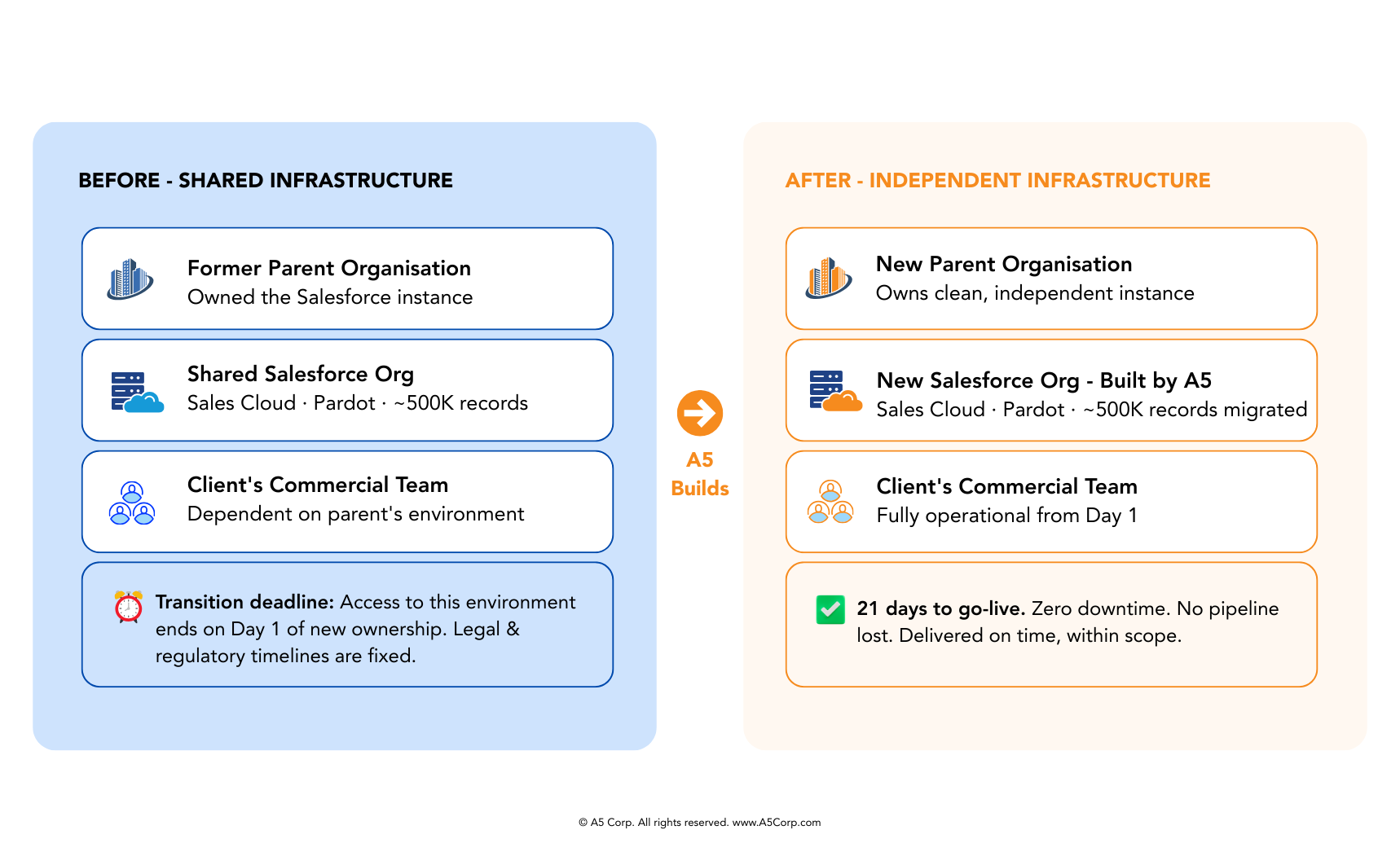
The client’s entire commercial operation ran on a Salesforce instance owned by its former parent organisation. That environment would cease to be accessible after transition day. The business needed its own clean, independent CRM — built from scratch, populated with almost 500,000 of its own records, and configured to reflect how its commercial team actually sells.
The separation was business-critical for four interconnected reasons:
✓ Acquisition support: The carve-out had to complete cleanly to support the wider acquisition of the former group entity.
✓ Regulatory compliance: Legal and regulatory requirements tied to the transaction had fixed deadlines that could not slip.
✓ Business continuity: The client’s commercial teams needed uninterrupted access to pipeline, contacts, and opportunities throughout the transition.
✓ Day 1 readiness: The new organisation had to be fully operational from the moment ownership transferred — not days or weeks later.
A5 was brought in to design, build, migrate, and deploy that environment in just three weeks. Here is exactly how we delivered a Salesforce implementation corporate carve-out programme — on time, without disruption, and built to last.
The Objective: Scope Discipline as the Only Path to Day 1
When a deadline is fixed by legal and regulatory timelines, there is no room for ambition to outrun reality. The temptation in a project like this is to fix everything at once. That temptation had to be resisted.
The brief A5 received was deliberately constrained. A purposeful, light-touch implementation — not an overengineered transformation. The mandate: get the client operational on Day 1 and build a foundation solid enough to grow on. That made scope discipline the most important decision on the project.
Four priorities were non-negotiable from the start:
- Standard objects only: Leverage standard Salesforce objects wherever possible — no unnecessary customisation consuming time the project didn’t have.
- Clean migration: Extract and migrate client-specific data from the legacy instance accurately and completely.
- No data cleansing: Avoid cleansing work that would expand scope and blow the timeline without adding Day 1 value.
- Scalable foundation: Establish a robust architecture the new organisation could build on with confidence for years to come.
Beyond infrastructure, the new system had to reflect how the client actually sells — supporting Leads, Accounts, Contacts, Opportunities, Campaigns, Products, Assets, Licences, and Revenue Schedules, with product scheduling functionality replacing legacy custom objects and opportunity management restructured for multi-product, multi-line item selling.
The Solution: A Unified Salesforce Revenue Engine — Built for Speed
A5 accepted the challenge. We didn’t just migrate the data — we delivered a business continuity programme, not a software deployment. A Salesforce implementation corporate carve-out demands more than technical configuration. It requires solving the human, process, and architectural problems that make technology either succeed or fail. That’s what a CRM implementation partner is actually for.
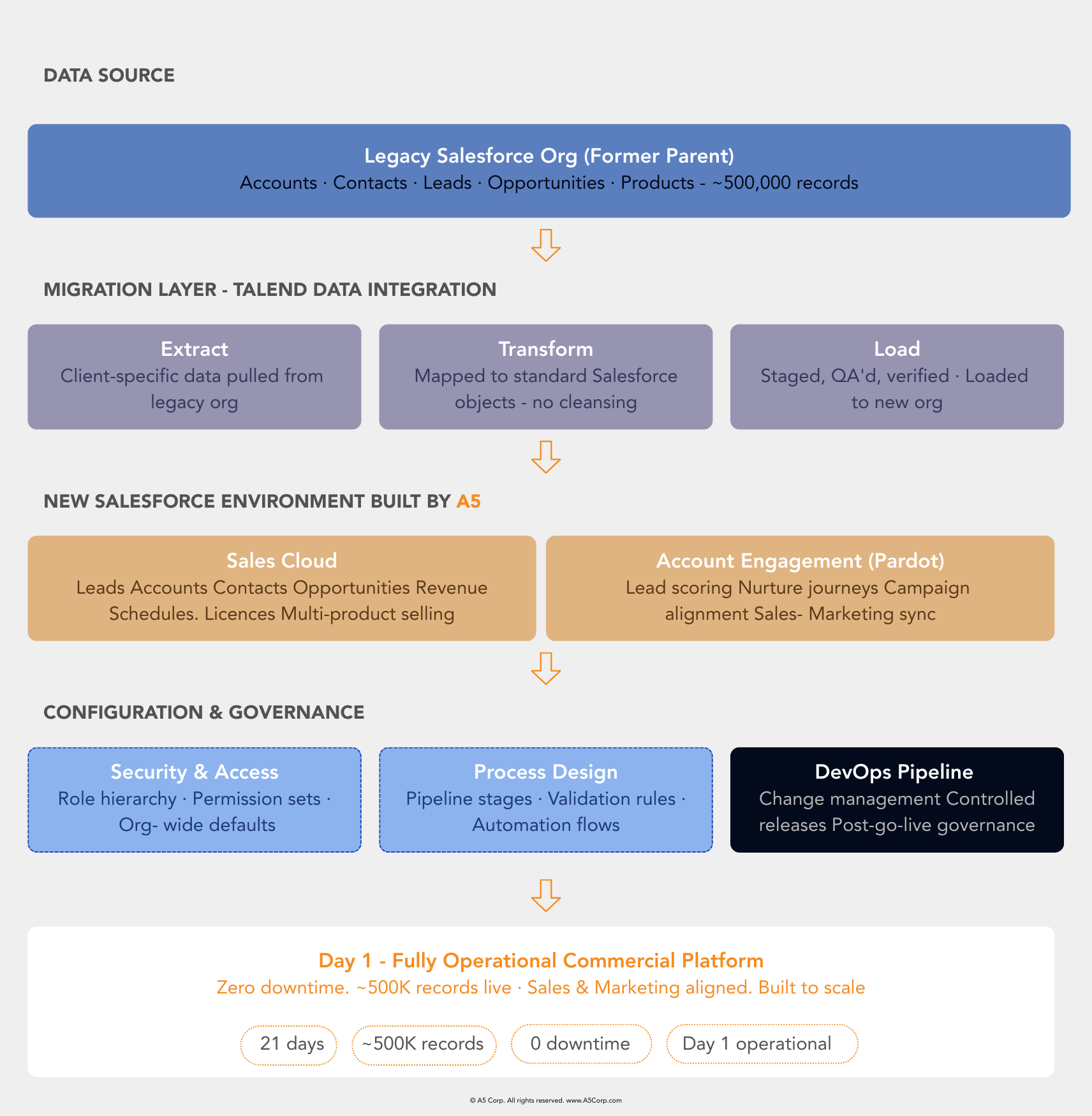
The Salesforce Org Migration: No Inherited Debt
A5 managed the Salesforce org migration from the legacy instance into a clean, independently provisioned environment — with no inherited configuration debt and no data the client didn’t own. We streamlined legacy configuration, replaced years of accumulated custom workarounds with purposeful out-of-the-box Salesforce features, and established the right access controls, security model, and governance structure from the ground up. The constraint of the timeline became an opportunity to build it better.
Sales Cloud & Account Engagement: Built for How the Client Actually Sells
Generic CRM configurations fail because they are built for hypothetical sales processes, not the one your team actually uses. When a system doesn’t reflect reality, reps work around it — and the moment that happens, data quality and adoption collapse. A5 configured Sales Cloud (Agentforce Sales) and Pardot (Agentforce B2B Automation) to match the client’s commercial model precisely:
- Revenue schedules: Aligned to advertising and reporting products.
- Multi-product opportunities: Restructured from single to multi-line item selling model.
- Campaign alignment: Sales and marketing processes connected end-to-end.
- Licence object: New custom object to store subscription details accurately.
- Pipeline management: Standardised yet flexible — leadership visibility without restricting how reps work.
The Salesforce Data Migration: Almost 500,000 Records in Under 3 Weeks
We utilised Talend to execute the Salesforce data migration — extracting client-specific data from the legacy Salesforce Sales Cloud instance and migrating Accounts, Contacts, Leads, Opportunities, and Products into the new environment. A5 transformed the data to fit the standard Salesforce model, enhancing long-term scalability without unnecessary complexity. Every record the commercial team needed on transition day was in the new system, verified and ready.
DevOps & Governance: Built for What Comes Next
A5 implemented a DevOps process for ongoing change management and controlled releases. The underlying data architecture, process design, security model, and governance structure were all built for long-term scale — not just immediate operational readiness.
Why It Worked: Process First. Scope Discipline Second. Technology Third.
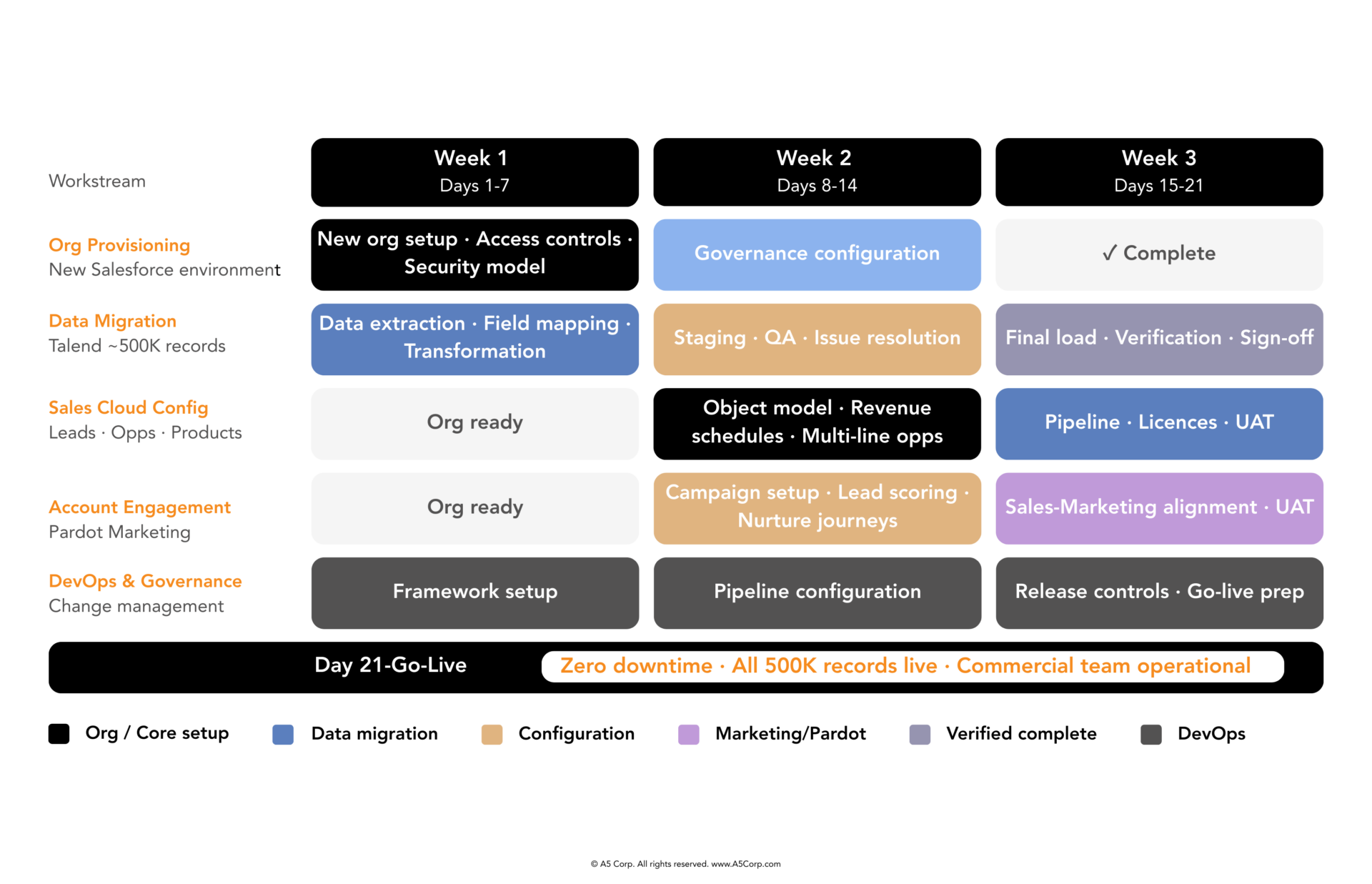
Why did this succeed? Because we treated the Salesforce implementation corporate carve-out as a strategic operation, not a technical ticket.This is how you deliver a clean, production-ready system in 21 days — not by moving faster, but by eliminating the rework cycles that slow most projects down.
Migration and Build Ran in Parallel
The Talend data migration workstream ran in parallel with platform configuration from week one. This was a deliberate architectural choice that kept the project on track without compromising what was delivered.
“The organisations that succeed with Salesforce sales and marketing alignment are the ones that design the process first and let the technology follow. Pardot and Sales Cloud are powerful— but they amplify whatever process you feed them. If you skip the alignment work upfront, you will automate the same dysfunction you already had. Just faster.”
–Senior Salesforce Revenue Architect, A5
The Impact: Day 1 Operational Readiness — Delivered
The results were unambiguous. On Day 1 of the new organisation, the client’s commercial team logged into their new Salesforce environment and worked without interruption, without productivity loss, and without a single piece of pipeline falling through the transition.
- Live in 21 days: Fully operational Salesforce Sales Cloud within three weeks of the project request.
- 500,000 records migrated: Accurately and without data loss — the team picked up exactly where they left off.
- Zero disruption: No downtime, no productivity loss, no pipeline dropped during the transition.
- Day 1 operational: Commercial team live and working in the new system from the moment ownership transferred.
- Compliance met: Regulatory and legal requirements fully supported throughout.
- Built to scale: Strong architectural foundation for long-term growth under new ownership.
Corporate carve-outs don’t have to be as painful as they look from the outside. With the right expertise, architectural discipline, and a partner who has operated under this kind of pressure before, Day 1 readiness is achievable — however tight the window.
Frequently Asked Questions on Salesforce Carve-Out Implementations
How long does it take to implement Salesforce during a corporate carve-out?
With disciplined scope management and a dedicated implementation partner, a light-touch Salesforce Sales Cloud environment can be live in as little as 21 days. This requires provisioning new orgs, configuring the platform to match existing sales processes, and running data migration in parallel with the build — not sequentially. The critical constraint is not technical speed but scope discipline: limiting customisation to what is strictly necessary and avoiding extensive data cleansing work that expands timelines without adding Day 1 value.
Can you migrate hundreds of thousands of CRM records in under three weeks?
Yes — with the right tooling and architectural decisions. Using Talend for extraction and transformation, A5 migrated almost 500,000 business records from a legacy Salesforce instance into a brand-new environment in under three weeks. The critical decision was to transform data to fit standard Salesforce objects rather than performing extensive cleansing, which protected the timeline without compromising data integrity or continuity.
What are the Salesforce migration risks in a carve-out?
The biggest Salesforce migration risk in a carve-out is scope creep. Well-intentioned decisions — like pursuing full data cleansing or building custom objects — can derail a go-live deadline. A5’s approach prioritises what is required for Day 1 operational readiness and defers everything else to a governed post-go-live roadmap.
What Salesforce products are needed for a carve-out CRM implementation?
A typical Salesforce implementation corporate carve-out uses Salesforce Sales Cloud (Agentforce Sales) and Marketing Cloud Account Engagement/(Pardot (Agentforce B2B Marketing Automation), alongside Talend for data migration and a DevOps framework for post-go-live change management.
How do you ensure a Salesforce implementation supports both Sales and Marketing from Day 1?
Alignment between Sales and Marketing in Salesforce is a process and governance decision, not a technical one. A CRM implementation partner configures campaign structures, lead management workflows, and shared pipeline visibility that connect Sales Cloud and Account Engagement into a single commercial model — configured to reflect how both teams actually operate, so adoption is immediate rather than requiring behaviour change under pressure.
Ready to move off a legacy CRM under carve-out pressure?
— your Salesforce Revenue Transformation partner — for a no-obligation assessment.