Decoding Quote-to-Cash Terminology: A Strategic Guide to Revenue Cloud Architecture

Quote-to-Cash terminology

If you’ve sat in a steering committee meeting recently, you’ve likely noticed a shift in the language. The conversation has moved from simple “quoting” to a complex alphabet soup of CPQ, RLM, RCA, ARM, LTC and QTC (often referred to as Q2C). For many business leaders, navigating this maze of Quote-to-Cash terminology feels less like strategy and more like a distraction — just another rebranding exercise from the software giants.

But dismiss it at your peril.

At A5, we’ve audited over 60 Quote-to-Cash implementations in the past three years. What we’ve discovered: 68% of stalled projects fail not because of technology limitations, but because stakeholders are using the same acronyms to mean fundamentally different things. The way we define these terms dictates how we build our systems. Get the definition wrong, and you risk building a fragile architecture that becomes technical debt within 18 months. Get it right, and you unlock the kind of agility that defines market leaders.

Whether you are a CIO, a CFO, or a RevOps leader, here is the strategic context you need to decode the evolving Quote-to-Cash terminology and build a roadmap for growth.

What is Quote-to-Cash (QTC)?

Before decoding the new acronyms, we must ground the definition. Mastering foundational Quote-to-Cash terminology is essential because QTC (or Q2C) refers to the end-to-end business process of driving revenue, starting from a customer’s intent to buy (configuration and pricing) and ending with revenue realization (billing and cash collection). Unlike Order-to-Cash (O2C), which begins only after the sale is closed, QTC encompasses the entire sales, legal, and finance lifecycle.

Quote-to-Cash (QTC) process flow chart showing the steps from Configuration and Pricing to Quoting, Contracting, Ordering, and Revenue Management.

The Timeline: How We Got Here

To understand the current acronyms, you have to understand the journey Salesforce took to get here. The confusion stems from three major shifts in strategy over the last decade:
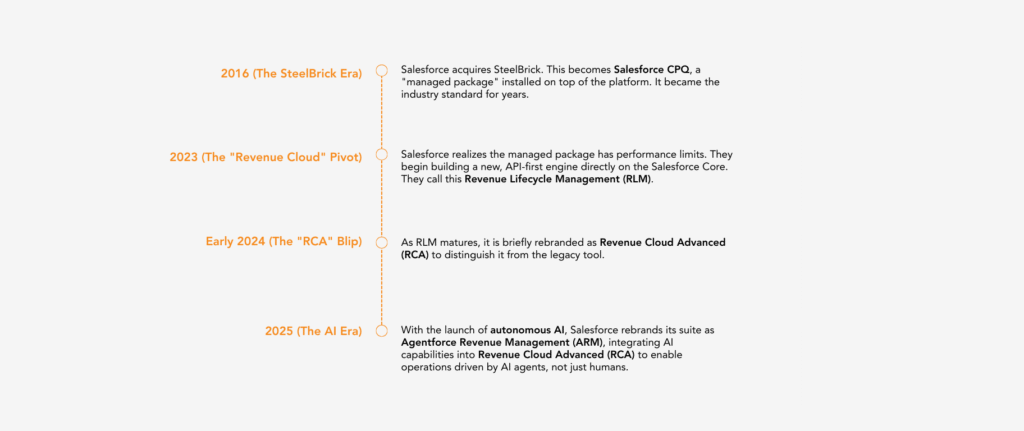
Salesforce revenue architecture timeline showing the evolution from SteelBrick CPQ to Revenue Lifecycle Management (RLM) and Agentforce Revenue Management (ARM).

Salesforce CPQ vs. Agentforce (RLM): The Architecture Shift

Now that you know the history, we can look at the architecture. The critical decision today is between the legacy standard (Salesforce CPQ) and the new engine (Agentforce/RLM). When weighing these options, understanding the nuances of modern Quote-to-Cash terminology is vital for your architecture strategy.

The Update: While the official name is now Agentforce Revenue Management, the underlying engine is still widely referred to by architects as RLM.

  • Salesforce CPQ (The Managed Package): Built as a package installed on top of the platform. It is excellent for straightforward configuration but can hit performance limits at extreme enterprise volumes.
  • RCA(The Engine): This is Revenue Cloud Advanced (earlier known as Revenue Lifecycle Management- RLM). It is the underlying, API-first architecture built on the Salesforce Core that allows pricing logic to be “headless.”
  • Agentforce (The Driver): The AI layer that sits on top of RCA. It uses autonomous agents to perform tasks like “Draft a quote for this renewal” or “Amend this contract based on the email request.”
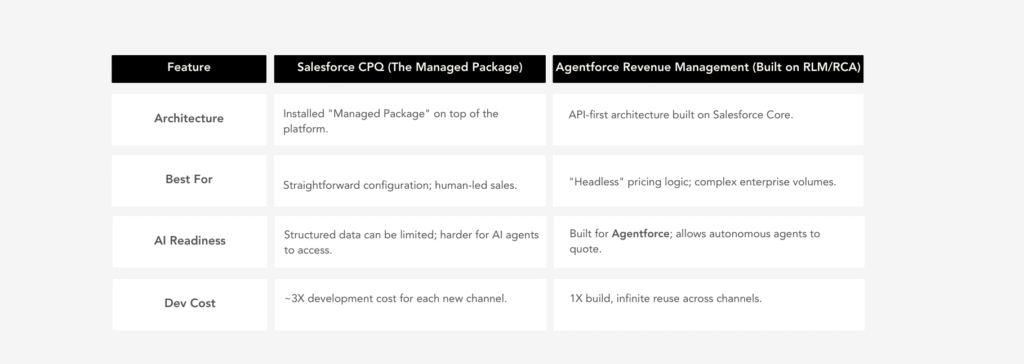
Comparison chart of Salesforce CPQ managed package architecture versus the API-first Agentforce Revenue Management (RLM) architecture.

The Consultant’s Take: When weighing Salesforce CPQ vs. Agentforce Revenue Management, remember: you cannot skip straight to AI. Autonomous agents require the structured, API-accessible data model of RLM/RCA to function. If you are still on legacy CPQ with unstructured data, your AI strategy will fail because the agents won’t have a “clean” map to read.

The CIO’s Calculation:

  • Legacy CPQ: 3X development cost for each new channel (web, mobile, partner).
  • Agentforce Revenue Management: 1X build, infinite reuse.

This API-first architecture is the only path that allows Agentforce agents to quote autonomously without expensive custom integration.

The "ARM" Conflict: A Tale of Two Systems

If there is one area where we see projects go off the rails, it’s the collision of the acronym ARM.

In a cruel twist of fate, both Salesforce and NetSuite (Oracle) utilize this acronym, and they both sit at the critical intersection of Sales and Finance. We recently audited a stalled $2.3M project where the team was trying to force Salesforce to handle complex, multi-book accounting compliance — simply because they bought a module called “Revenue Management.”

Here is the clarity you need to bridge the gap between IT and Finance:

  • Salesforce ARM (Agentforce Revenue Management) is your windshield. It is designed for Operational Forecasting. It allows your RevOps team to see revenue schedules and manage contract amendments before the invoice is finalized. It answers the question: “How much revenue will we recognize next quarter?

  • NetSuite ARM (Advanced Revenue Management) is your rearview mirror (and your auditor’s best friend). It lives in the ERP and is the system of record for ASC 606 compliance. It answers the question: “Is this financial report legally accurate?”

The Strategic Fix: Don’t treat these as competing tools. Use Salesforce to capture the operational intent (the Order) and pass it to NetSuite to handle the heavy compliance math. Clarity in roles prevents redundancy in integration.

The CFO’s Risk Assessment: We’ve seen companies face audit findings because they treated operational forecasting tools as systems of record. The remediation cost? One client spent $800K unwinding revenue recognition errors that stemmed from this exact confusion.

A Glossary of Modern Quote-to-Cash Terminology

When we kick off a digital transformation, one of our first steps is harmonizing the language. Ambiguity creates technical debt. Here is the “cheat sheet” regarding Quote-to-Cash terminology we recommend for your internal teams:

The Modern Quote-to-Cash Architecture Flow

To visualize how these terms fit together, consider the sequential flow of data:

  1. Configuration: Selecting bundled products and attributes.
  2. Pricing: Applying logic and margins.
  3. Quoting: Generating the document.
  4. Contracting (CLM): Legal negotiation.
  5. Ordering: Converting quote to order.
  6. Revenue Management: Forecasting and Recognition.

Key Definitions

L2C (Lead-to-Cash): The “Full Lifecycle.” Common in European markets, covering everything from the first Marketing Lead to the final Cash collection.

    • Executive impact: The only view that shows true customer acquisition cost vs. lifetime value.

QTC / Q2C (Quote-to-Cash): The holistic quoting process within L2C. It’s not a software; it’s the journey your customer takes from “I’m interested” to “Invoice Paid.”

    • RevOps impact: End-to-end visibility reduces sales cycle by 15-30%.

CPQ (Configure, Price, Quote): The holistic process within Q2C that guarantees accurate pricing. It stops sales reps from selling products that don’t exist at prices you can’t honor.  Also can refer to the specific Salesforce CPQ software (formerly Steelbrick)

    • Sales impact: Reduces quote errors by 70-85% in our client implementations.

RLM/RCA (Revenue Lifecycle Management / Revenue Cloud Advanced): The next-generation architecture. Think of this as the “brain” of revenue that can be accessed by any “limb” (web, mobile, partner portal).

    • CIO impact: Enables channel expansion without proportional IT investment.

ARM (Agentforce Revenue Management): The next-generation architecture enhanced with Agentforce for agentic AI-driven revenue management.

CLM (Contract Lifecycle Management): The legal layer. We often see companies disconnect this from quote, leading to “leakage” where the signed contract doesn’t match the approved quote.

    • Finance impact: Unintegrated CLM costs companies an average of 3-7% of contract value in unbilled services and pricing mismatches.

What This Means for Your Role

For the CFO: Financial Risk and Opportunity Cost

The terminology confusion isn’t just annoying — it’s expensive. When teams misalign on what “Revenue Management” means, we see:

  • Audit risk exposure: Using operational tools as compliance systems of record
  • Revenue leakage: 3-7% of contract value lost to mismatched quotes and contracts
  • Forecasting inaccuracy: Revenue predictions off by 15-25% due to siloed data
  • Delayed close: Month-end close taking 2-4 extra days due to manual reconciliation

The A5 Framework:

We use a three-layer revenue governance model that clearly separates operational capture (CRM), revenue intelligence (middleware), and compliance recording (ERP). This prevents the “one system to rule them all” trap that creates both IT complexity and audit exposure.

For the CIO: Architecture Decisions with 5-Year Consequences

With AI entering the quote process, these architectural decisions are becoming permanent faster than ever. The systems you choose today will either enable or constrain your AI strategy tomorrow.

The critical decision: Are you building a monolithic revenue system or a composable revenue architecture?

Our assessment shows that companies with composable architectures (RCA-style, API-first) can integrate new AI pricing models in 4-6 weeks. Companies with legacy, tightly-coupled systems are looking at 6-9 month projects for the same capability.

The A5 Maturity Model:

We assess clients across five dimensions: Data Architecture, Process Integration, Channel Readiness, Compliance Separation, and AI-Readiness. Most companies score 2.1 out of 5. Market leaders score 4.2+.

For RevOps: Speed and Accuracy as Competitive Advantage

Your team lives in the gap between what Sales promises and what Finance can deliver. Terminology confusion makes that gap wider. When your CPQ, CLM, and ARM systems speak different languages:

  • Quote-to-contract time increases by 40-60%
  • Amendment cycles take 2-3X longer than they should
  • Revenue forecasts require manual spreadsheet reconciliation
  • Deal desk becomes a bottleneck instead of an accelerator

The A5 Approach:

We map your quote-to-cash process before we touch technology. We’ve found that 80% of “system problems” are actually process ambiguity problems. Our Process Design Workshops align stakeholders on definitions before a single field is configured.

The A5 Revenue Architecture Diagnostic

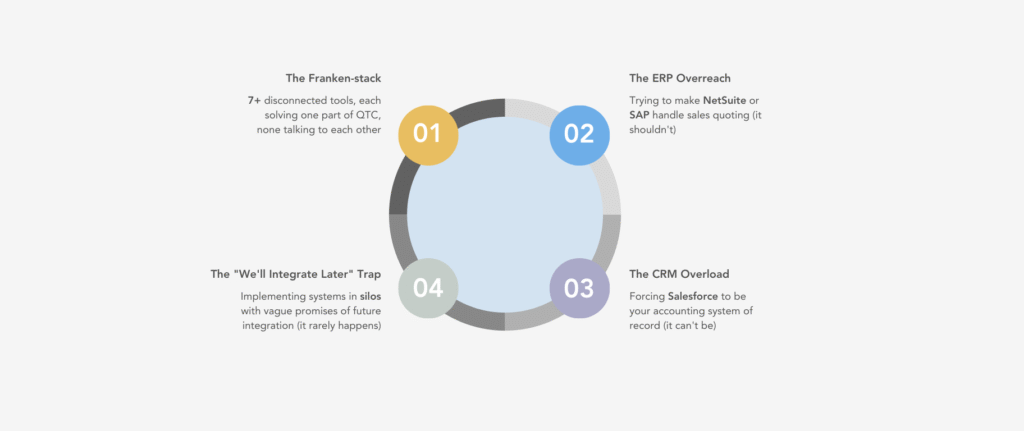
Here’s the uncomfortable truth: Most companies are over-investing in CLM and under-investing in ARM. They’re spending six figures on contract management tools while their sales teams are still building quotes in spreadsheets. They’re implementing sophisticated revenue recognition engines while their order-to-invoice process is held together with manual data entry.

We see four common anti-patterns:
Take the Assessment

Answer these five questions honestly:

  1. Can your sales team generate a legally-binding quote in under 30 minutes for your most complex product?
  2. If you launched a self-service portal tomorrow, could it use the same pricing logic as your sales team?
  3. Does your RevOps team trust the revenue forecast in your CRM, or do they maintain shadow spreadsheets?
  4. Can you amend a contract without involving three departments and a two-week approval cycle?
  5. If your auditor asked for the revenue recognition logic for a specific deal, could you produce it in under 24 hours?

If you answered “no” to two or more, you have architecture debt, not just terminology confusion.

What Separates Leaders from Laggards

The companies winning in the new revenue economy share three characteristics:

  1. Architectural Clarity: They know exactly which system is responsible for what, and they resist the temptation to make one system do everything.
  2. Process-First Thinking: They map the business process before selecting technology, not the other way around.
  3. Composable Design: They build systems that can be reconfigured as the business evolves, not monolithic platforms that require 18-month projects to change.

At A5, we don’t just implement software. We architect revenue systems that serve your strategy, not the other way around. Our Revenue Architecture Blueprint has helped clients reduce quote-to-cash cycle time by 40%, eliminate revenue leakage of 3-7%, and achieve audit-ready compliance without sacrificing sales agility.

Your Next Step: The Revenue Architecture Readiness Assessment

The future of revenue is integrated, intelligent, and fast. But you can’t build that future on a foundation of confusion. We can help you cut through the noise of complex Quote-to-Cash terminology and build a revenue architecture that scales.

We’re offering a complimentary Revenue Architecture Readiness Assessment to qualified organizations. In a 90-minute working session, we’ll:

  • Map your current QTC architecture and identify integration gaps
  • Benchmark your maturity against industry leaders in your sector
  • Identify the top three architectural decisions that will unlock or constrain your growth
  • Provide a prioritized roadmap with estimated ROI for each initiative

This isn’t a sales pitch disguised as a meeting. It’s a diagnostic session led by our Principal Salesforce Revenue Architects who have designed revenue systems for companies from $50M to $5B in revenue.

The catch: We only have capacity for 8 assessments per quarter, and we’re selective about fit. This is designed for organizations with complex revenue models (subscriptions, usage-based, multi-entity) who are serious about transforming their quote-to-cash process in the next 12 months.

If you’re ready to move beyond the alphabet soup and start building a revenue architecture that scales, Request Your Assessment Here or email us directly at info@A5corp.com to start the conversation.

The terminology will keep evolving. Your architecture shouldn’t have to.

Get the latest articles right in your inbox

Explore our posts

Subscribe To Our Newsletter

Subscribe To Our Newsletter For Exclusive Content And Industry Updates.

Satch Patel, Executive Vice President, MD, UK & EMEA

Satch brings 25+yrs of enterprise global solution experience having contributed to the growth of some of the worlds largest marquee software and hardware giants in the industry from Oracle Corporation, Sun Microsystems, Cisco/EMC, to Apttus & Salesforce.
 
Satch has helped many blue chip organisations realise their vision to modernize their systems from the front office to back office revenue operations to meet the demands of today’s radically transforming and digitally-driven business models, having worked with the likes of Linklaters, CliffordChance, Barclays, RELX Group, Microfocus, Novartis, Siemens, PayPal, Vista Equity Group Companies, London Stock Exchange, TPICAP and Princes Trust.
 
With his leadership approach, experience and passion for helping companies drive transformative change, Satch has a deep expertise in many industries, technologies and best practices across the lead to revenue lifecycle and how driving such digital transformation(s) can improve business growth and increase operational efficiencies  as well as preparing businesses for M&A activities.

Brion Schweers, Board Observer

Brion Schweers is a Senior Vice President of Product Management at Salesforce, currently managing the Revenue Cloud Solution Excellence team. During the past 30 years, Brion has assisted enterprises around the world in transforming their business by focusing on their Product-to-Cash processes. Prior to joining Salesforce Brion was VP & GM, CPQ at Apttus, VP, Sales & Success at A5 Consulting, served on the OAUG ConfigSIG Board and spent 15 years at Oracle in various roles related to their CX and CPQ products. Brion is also the executive Sponsor of Vetforce – Carolinas and is actively involved in the Salesforce Military program where he mentors Veterans and their spouses with actionable, personalized career advice.

Joseph Truhe, Board Member

Joseph Truhe has over 20 years of investing experience. Prior to joining Jefferson Capital in 2013 Joseph was a Portfolio Manager with Whitney Bank in New Orleans, Louisiana, where he oversaw the company’s Trust accounts and served as the Energy sector analyst for the Hancock Horizon Funds. Prior to Whitney, Joseph worked as an analyst and member of the investment committee at HFR Asset Management, a multi-billion dollar hedge fund platform in Chicago, Illinois. There, Joseph reviewed and maintained investment discretion over the firm’s Event Driven and Asia-focused hedge fund allocations. He was also responsible for the expansion of the firm’s Asia-focused fund offerings.  Joseph holds a BA in Economics from Yale University.

Steve Swartzman, Board Member

Steve Swartzman is a Principal and co-founder of CPC. Previously, as a co-founder of C3 Capital, he helped originate and manage over 35 investments, including national brands such as American Apparel, Traeger Grills, and Grunt Style. Steve’s chief focus remains consumer brands and e-commerce enablement businesses, and he currently serves on the boards of Grunt Style, Accel Clinical Research, Spoke Custom Products, Warne Scope Mounts, and New World Natural Brands.

Prior to C3, Steve structured and managed subordinated debt investments at KC Venture Group, and he spent 7 years as a Vice President with Citibank in New York, managing client relationships for emerging markets clients and structuring over $1 billion in complex trade financings. He is a past President of the Midwest chapter of the Small Business Investment Alliance, and he serves on the board of the International Center for Music at Park University in Kansas City.

Steve received a MBA from Columbia Business School and an AB in History and Literature from Harvard College.

He resides in Kansas City, where he was raised, with his wife Evelina and two sons, Harrison and Zandy. When he’s not working, his favorite activities are fishing, golfing, and eating.

Charles Scripps, Board Member

Chad has over ten years of experience investing in dynamic, growing businesses in diverse industries and geographies. His private equity experience includes HIG Capital, which has over $12B in capital under management, and AEA Investors, which manages over $3B of invested and committed capital. While at HIG and AEA, Chad led diligence, structuring, and financial analysis of potential and existing investments, and completed transactions in the industrial products and consumer services industries. Chad also has experience investing in the public equity markets, most notably as a Managing Director at Fox Point Capital, a $1B fund seeded by Julian Robertson of Tiger Management. He invested across a number of industries, including industrials, financials, technology, and consumer products, and led Fox Point’s international research. Prior to focusing his career on investing, Chad was a management consultant at McKinsey and Company, solving strategic problems for the world’s leading companies. Chad earned an MBA with Honors in Finance from the Wharton School at the University of Pennsylvania and a BS with Distinction in Chemical Engineering from the University of Wisconsin-Madison.

Lester F. Alexander II, Board Member

Les Alexander is a partner with Jefferson Capital Partners where he provides mezzanine and equity capital for growth and buyout transactions. Mr. Alexander is a member of the firm’s investment committee and serves on the board of directors of several portfolio companies where he is actively involved in strategic planning and corporate governance. Prior to joining Jefferson Capital, he worked at Advantage Capital Partners where he completed several portfolio company investments and served on the investment committee. Before becoming a private equity investor, Mr. Alexander served as president of Ferrara Fire Apparatus, Inc., a leading fire truck and emergency vehicle manufacturer. At Ferrara, he was responsible for managing a workforce of 450 employees producing over 300 vehicles annually for its domestic and international customers. As an investment banker for 15 years with such firms as Howard Weil, Southcoast Capital, and J.C. Bradford & Co., Mr. Alexander completed over 50 public offerings of debt and equity securities, private placements, and merger and acquisition transactions totaling more than $7 billion for public and private companies in a variety of industries. Mr. Alexander is an adjunct professor at Tulane University and Loyola University where he teaches graduate and undergraduate classes in investment banking, private equity & venture capital, advanced financial management, investments, and entrepreneurship. He is also the board president for Benjamin Franklin High School, a public charter school in New Orleans. Mr. Alexander is the former Chairman Finance of the Association for Corporate Growth (ACG) and served on the global Board of Directors. He is a founder of the Louisiana chapter of ACG and was a recipient of the ACG global Meritorious Service Award and the Louisiana chapter’s Outstanding Service Award. Mr. Alexander received his bachelor of science in Commerce from the University of Virginia in 1989 and his MBA from the University of North Carolina in 1993.

Patrick F. Healy, Board Member

Based in Kansas City, Mr. Healy is a co-founder of C3 Capital. He has been an active private equity investor since 1985 and was a co-founder of C3 Holdings in 1994. Prior to this time, he sponsored and structured equity investments in real estate. He gained extensive workout and restructuring experience as chair of the creditor’s committee of a $1 billion bankruptcy and from being called upon to rescue a publicly-traded company from a major fraud. Mr. Healy was a senior tax partner at Mayer Hoffman McCann, a regional CPA firm, for eleven years. He received a Bachelor of Science in Accounting from the University of Kansas.

Chris Waters, VP of Strategic Sales

As Vice President of Strategic Sales, Chris guides and influences all strategic sales activities at A5 , starting in presales activities, successful sales methodology, sales process, and continued revenue generation and expansion opportunities. Furthermore, he will provide oversight in strategic sales function for the company and develop strategic sales plans that will promote growth in sales and customer satisfaction. Chris has proven his commitment to sales leadership and organizational success through field leadership as National Sales Manager at Deluxe Corporation, Field Sales Manager within the Social / Analytics Cloud at Oracle, US Regional Manager for CPQ Major Accounts at Oracle and now as Vice President on Sr. Leadership Team at A5.

Keith Fox, GM Salesforce Canada

Keith Fox is a software and consulting veteran for the past 34 years. Keith started his career at EDS which was followed by 4-year stint offshore in Bermuda. Keith then returned to Canada where he held a number of progressive sales and technical positions with software companies such as Sybase, BEA, and Oracle. After his stint with Oracle, Keith founded Cloudware Connections, a premier Salesforce consulting partner. 11 years down the line, Cloudware was acquired by A5, and Keith joined as GM for Canada.

Tarun Sharma, Vice President Delivery

Tarun Sharma is Vice President Delivery at A5 and is responsible for customer success, project operations, recruitment, resource utilization, and sales operations functions for Oracle practice. As a business and technology leader Tarun helps businesses develop solution strategies to streamline the sales process and improve customer relations to drive revenues, profits, and build brand loyalty. Tarun has led customers through digital transformation journeys. He has commanded strategic and tactical initiatives to shorten sales cycles, increase deal values and productivity, improve brand awareness and help organizations become easier to do business with. He has helped customers modernize their sales enablement tools and present a single source of information to support an omni-channel sales approach. This includes global roll-out for multiple business units included multi-currency and multi-language. Tarun graduated from Texas A&M University with a Master’s degree in Industrial Engineering.

Adam Rosenfield, VP of Salesforce Practice

As Vice President of A5’s consulting practice – Adam is responsible for both strategic alliances with partners and expanded sales growth through the entire portfolio of A5 services. With over 20 years of Sr. level management consulting expertise – Adam has worn multiple hats in his career including practice development, sales, and client advisory. He has sold & delivered countless enterprise transformational initiatives creating a measurable competitive advantage for his customers. In addition to various technical software certifications, Adam holds an undergraduate and master’s degree in Accounting & Information Technology from the University of Texas at Austin and resides in El Paso Texas with his wife and 3 children.

PJ Alfrejd, CFO

As the CFO, PJ is responsible for all things financial at A5. With over 20 years of experience in financial leadership positions, PJ has worn all the hats required of a growing tech business. His extensive knowledge of the consulting industry, experience with M&A, and strength in operational finance is another catalyst to take A5 to the next level in its growth trajectory. PJ is a CPA with a BS in Accounting from the University of Illinois, Urbana-Champaign, and has held various finance leadership positions at Exodus/Savvis (acquired by Centurylink), Neohapsis (acquired by Cisco), and mFoundry (acquired by FIS).

Vinay Kruttiventi, President & CEO / Chairman of the Board

As the CEO of A5, Vinay plays an active role in all aspects of day-to-day business operations. He is also actively involved in establishing a strategy and vision for the company. As a true customer advocate with Salesforce and Oracle product development, Vinay is actively engaged in various industry user/special interest groups. Since founding the company in 2004, Vinay has grown the business into a leading Salesforce, and Oracle partner focused on multi-cloud transformations.

Vinay has successfully implemented and architected CPQ solutions and multi-cloud complex transformation projects for various Fortune 500 companies since 1996. He has a strong authority over industry, process, and technology in Configure-Price-Quote and ERP applications. Vinay graduated from Osmania University with a Bachelor of Engineering degree and JNTU (Jawaharlal Nehru Technical University) with a Master in Technology degree.